How to play Nine Men's Morris: rules and winning tactics
✍️ Güncel Oyun Oyna Team 📅 ⏱ 7 min read
Nine Men's Morris is a two-player strategy game played with nine pieces each, and it has no luck in it at all. No dice, no cards: everything is on the board in front of both players. That means every game you lose was lost in a specific move, and the more you play, the more clearly you start to see them. This guide walks through all the rules from the empty board to the final piece, then shows the mistakes beginners make most and the tactics that genuinely win games. Open our Nine Men's Morris game as you read and you can try every rule on the board straight away.
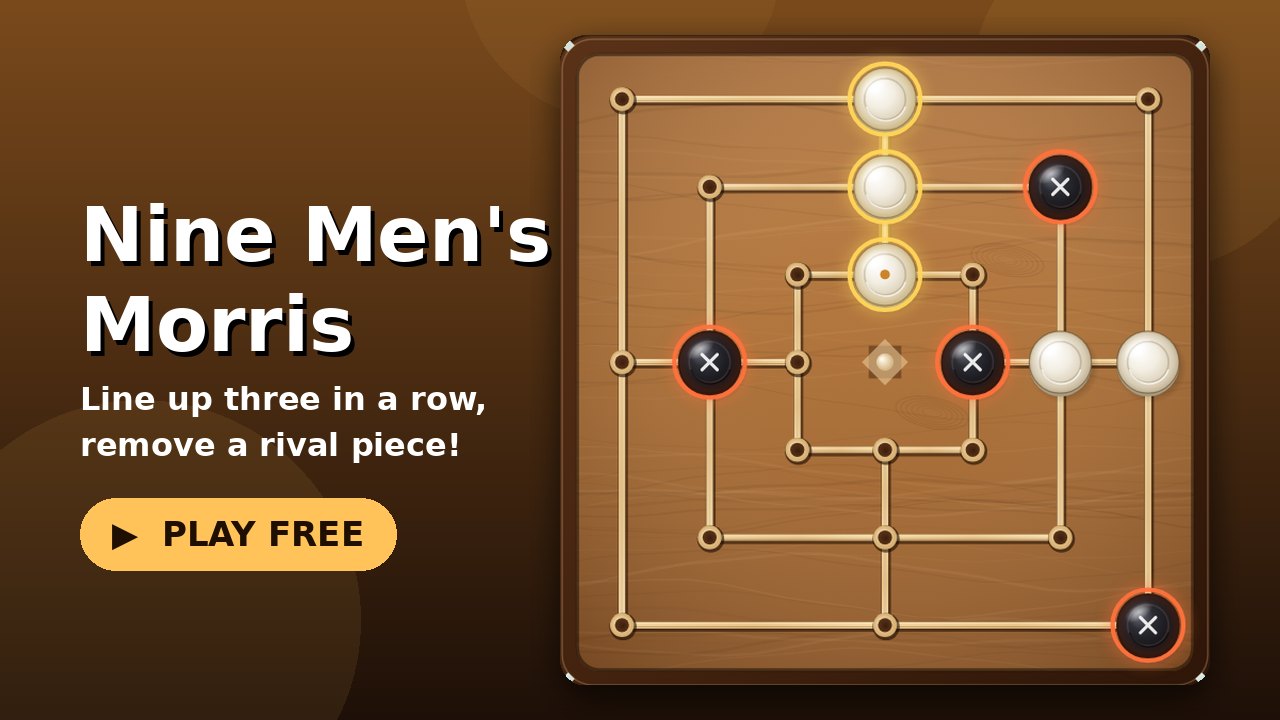
The board: three squares and 24 points
The board is made of three nested squares. The outer, middle and inner squares are joined by four short lines running through the middle of their sides. Pieces are not placed inside the squares but on the points where lines meet. Each square has 8 points, 4 corners and 4 midpoints, for 24 points in total.
Not all points are equal. How many neighbours a point has decides how free a piece placed there will be for the rest of the game.
| Point type | How many | Neighbours |
|---|---|---|
| Corners of the squares | 12 | 2 |
| Midpoints of the outer and inner squares | 8 | 3 |
| Midpoints of the middle square | 4 | 4 |
There are 16 possible mills on the board: the four sides of each square (12 lines) plus the four short lines joining the squares. Every point belongs to exactly two of these lines.
Setting up and taking turns
The board starts empty. Each player holds 9 pieces, one side white and the other black. By tradition White moves first. In our game you can pick your colour in the setup window when playing the computer. At online tables the colours swap every game, so the first-move advantage alternates between the two players.
Phase 1: placing
Players take turns putting one piece from their hand on any empty point. The phase lasts until all 9 pieces of both players are on the board, which is 18 moves. Mills can be formed and pieces removed during this phase too, so placing is far from quiet. More often than not, the game is decided right here.
Phase 2: moving
Once your hand is empty, each turn you slide one of your pieces along a line to an empty neighbouring point. There is no jumping, no diagonal moves and no passing. A player who cannot move a single piece on their turn, because they are completely blocked, loses.
Phase 3: flying
A player with only 3 pieces left no longer has to slide: they may fly any piece to any empty point on the board. Flying gives the player in trouble one last chance to defend and attack. While your opponent is still sliding with four or more pieces, being able to land anywhere can turn the game around in a single move.
💡 Some people play without the flying rule. Against the computer in our game you can switch it off in the setup window; at online tables it is always on.
Forming mills and removing pieces
The heart of the game is the mill. If your move fills all three points of a line with your own pieces, you remove one of your opponent's pieces from the board. Three details matter:
- Pieces in a mill are protected. If your opponent has pieces outside mills, you must take one of those.
- Protection ends when everything is in a mill. If all of your opponent's pieces are in formed mills, you may take any of them.
- One move, one piece. Even if a single move completes two mills at once, you remove only one piece.
Opening a mill by sliding one piece out and closing it again on a later turn counts as a new mill and removes another piece. The strongest tactic in the game is built on this rule.
How does the game end?
| Situation | Result |
|---|---|
| A player is down to 2 pieces | That player loses (they can no longer form a mill) |
| The player to move cannot move any piece | That player loses |
| The same position appears for the 3rd time with the same player to move | Draw |
| No piece is removed for 50 moves in the moving phase | Draw |
| No piece is removed for 20 moves while someone is flying | Draw |
The draw rules stop games from dragging on forever in positions neither side can win. In our game, when a draw is getting close the status line warns you with "draw in … moves without a capture".
Common beginner mistakes
- Piling into corners. Corner points only have two neighbours. A player who fills corners while placing finds their pieces blocked as soon as the moving phase begins.
- Chasing a mill at every chance. An open pair during placement is an invitation to block. Your opponent closes it and you lose both a tempo and flexibility.
- Missing your opponent's pairs. Before every move, check which lines hold two of your opponent's pieces with the third point empty. This one habit saves half the pieces you would otherwise lose.
- Underestimating a flyer. When your opponent is down to 3 pieces they can land anywhere. One open pair is enough to turn a game you thought you had won into a draw or a loss.
Tactics that win games
Take the crossroads of the middle square
The four midpoints of the middle square connect in four directions. Pieces there control two lines and have the most freedom in the moving phase. Grabbing one or two of these points in your first placing moves is a strong start.
Make two threats at once
If one piece creates open pairs on two different lines, your opponent can only block one and the other becomes a mill. Think of it as a fork. While placing, spread your pieces so that a fork is available on your next move.
The double mill: your strongest weapon
Arrange two mills so that one shared piece can shuttle between them. Each time it slides one way, a mill closes and you remove a piece; when it slides back, the other mill closes and you remove another. Unless your opponent can push a piece into the gap, they lose a piece every two moves and the game is over quickly. To build one, keep your pieces close together and mobile as you enter the moving phase.
Block your opponent
You can win without capturing anything. Fill the neighbouring points around your opponent's pieces and sooner or later they will have no legal move and lose. If their pieces are squeezed into corners and edges, a blocking plan is often faster than chasing mills.
Stay calm when flying
Down to 3 pieces? Don't panic: you can now land anywhere, so you can close any pair of theirs immediately. If your opponent is the one flying, spread your pieces so they can't bring two of theirs onto one line, and count the open lines after every move.
💡 Our Hard computer opponent is very good at spotting double mills and blocking chances. Practise these ideas on Easy and Medium first, then take on Hard; it's the most enjoyable way to learn.
Frequently asked questions
Is Nine Men's Morris the same as Mill or Merels?
Yes. The game is known around the world as Mill, Merels or Morris, and in Turkey as Dokuz Taş or Değirmen. The core rules are the same everywhere; the flying rule is the most common variation.
Has the game been solved?
Yes. Exhaustive computer searches in the 1990s showed that with perfect play from both sides the game ends in a draw. Between humans, though, flawless games almost never happen; the winner is usually whoever spots the other's first mistake.
Where can I play?
On our Nine Men's Morris page you can play free against the computer at three levels, with two players on one device, or at an online table against a real opponent. If you enjoy counting and sowing, give Mangala a try too.
#dokuz taş kuralları#dokuz taş nasıl oynanır#değirmen oyunu#üçlü#uçma kuralı#akıl ve zeka oyunları
Related guides
 🀄 Card & Board Games
How to play backgammon (tavla): rules, dice, hitting, bearing off and openings
Backgammon rules from start to finish: the setup, dice and doubles, points and blots, hitting and entering, bearing off, gammons and the best opening moves.
 🀄 Card & Board Games
How to play Okey: the complete rules from deal to finish
Okey rules step by step: the 106 tiles, the indicator and the joker, runs and groups, finishing with pairs and how points work on Güncel Oyun Oyna.
 📚 Learning
Turkey's 81 provinces and plate codes: easy ways to learn them and a Turkey Map Master guide
The logic of Turkish plate codes (01-67 alphabetical, 68-81 by creation date), all 81 provinces by region, memory techniques that stick and the Turkey Map Master modes.